Star or Delta? Reading 230/400 V and 400/690 V on a Motor Nameplate
What 230/400 V and 400/690 V mean on a motor nameplate: delta for the lower voltage, star for the higher, and how line and phase voltage relate.
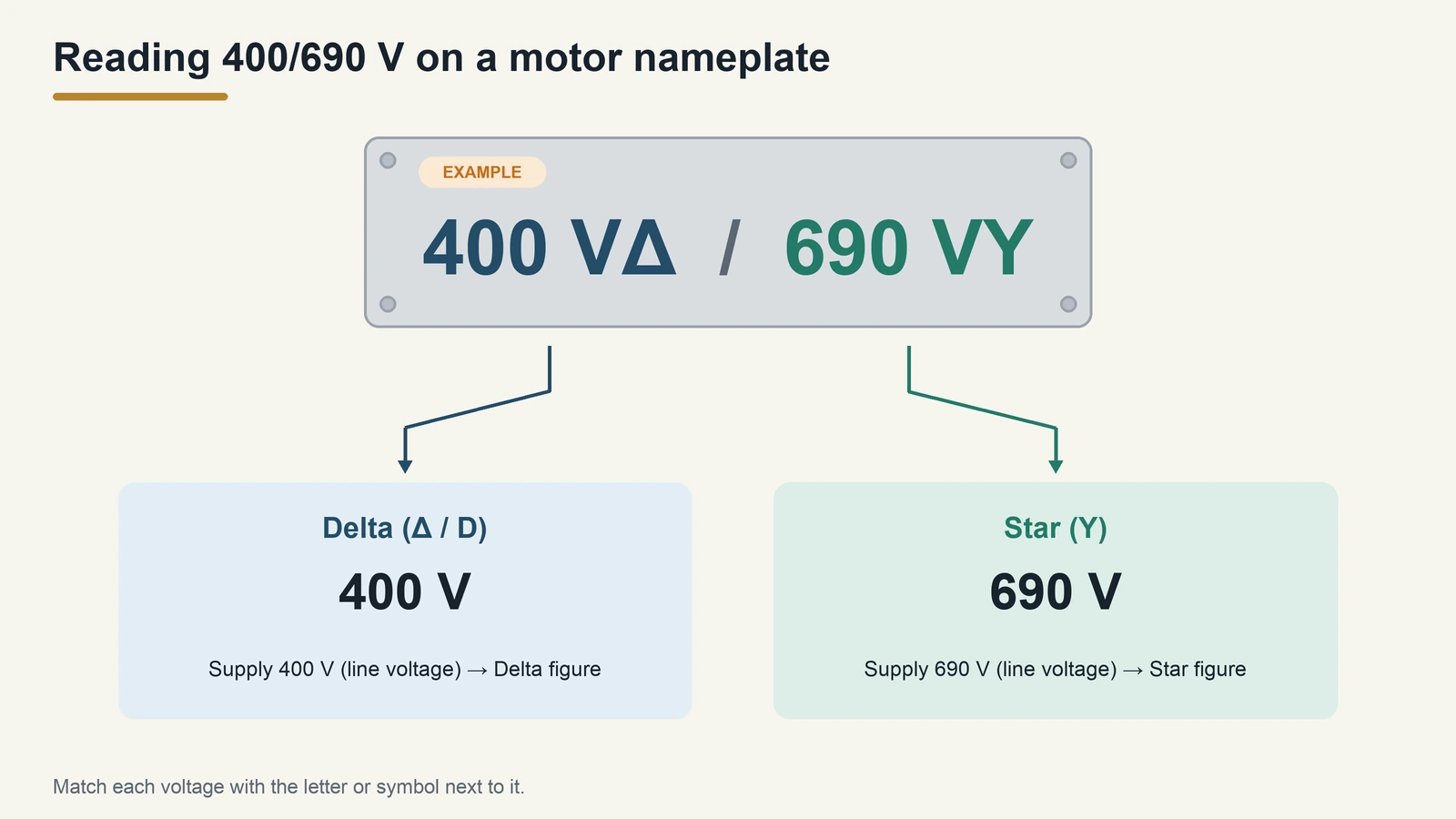
A three-phase motor nameplate that shows two voltages, such as 230/400 V or 400/690 V, is telling you the rated voltage for each of two winding connections. The lower voltage is for delta (Δ, also written D). The higher voltage is for star (Y). ABB's motor manual gives the example directly: "690 VY, 400 VD indicates Y-connection for 690 V and D-connection for 400 V." To read the plate, compare your supply's line voltage with the two figures.
This page explains how to read those figures. It isn't a wiring guide. Connecting a motor is work for a qualified electrician, with the power off, after measuring the supply and following the connection diagram supplied with the motor.
What do the two voltages on a motor nameplate mean?
Each figure is a rated voltage paired with a connection:
| Nameplate | Delta (Δ / D) | Star (Y) |
|---|---|---|
| 230/400 V | 230 V | 400 V |
| 400/690 V | 400 V | 690 V |
Plates write this in different ways, for example "230/400 V Δ/Y," "400 VΔ / 690 VY" or "690 VY, 400 VD." Match each voltage with the letter or symbol next to it, as in ABB's example "690 VY, 400 VD."
On a dual-voltage plate there are usually two currents, one for each voltage; our guide to reading a motor nameplate covers this and the other fields.
What are line voltage and phase voltage?
Two voltages exist in a three-phase system. The Indian government's electrician trade theory textbook defines them this way:
- Line voltage is "the potential difference across any two lines."
- Phase voltage is the potential difference "from a line to the star point."
In this guide, a supply voltage such as 400 V means the line voltage.
Why does star take the higher voltage?
Because the two connections put different voltages across each winding.
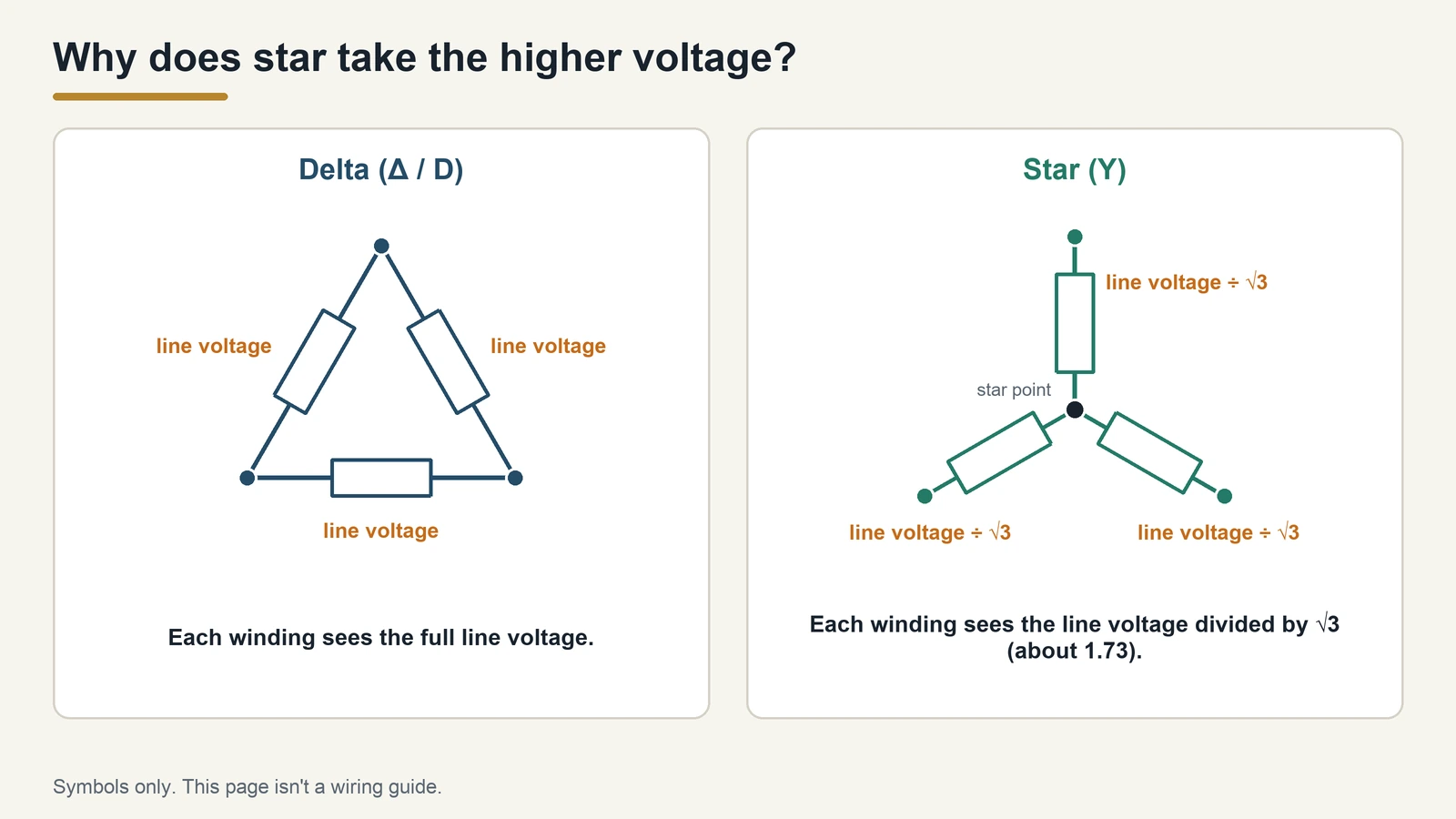
- In delta, "the line voltage appears across each of the load phases." Each winding sees the full line voltage.
- In star, "the line voltage is always √3 times the phase-to-neutral voltage." Each winding sees the line voltage divided by √3 (about 1.73).
So the same winding can be rated for two supply voltages that differ by a factor of about 1.73. Take a 400/690 V motor: in delta on a 400 V supply, each winding sees 400 V. In star on a 690 V supply, each winding sees 690 ÷ 1.73, which is about 400 V. The winding sees the same voltage either way. The 230/400 V motor works the same way one step down: about 230 V across each winding in both cases.
Which figure matches my supply?
Find the figure on the plate that equals your supply's line voltage:
| Your supply (line voltage) | 230/400 V motor | 400/690 V motor |
|---|---|---|
| 230 V | Delta figure | Not on the plate |
| 400 V | Star figure | Delta figure |
| 690 V | Not on the plate | Star figure |
If your supply voltage is not on the plate, the plate doesn't cover your supply. Ask the supplier for a motor with the right voltage rather than guessing.
Check frequency too. ABB's motor guide notes a supply tolerance of ±5% on voltage and ±2% on frequency under IEC 60034-1. Our post on 50 Hz vs 60 Hz motor supply covers frequency.
What does this mean for star-delta starting?
Star-delta starting runs the motor in star at start-up and in delta for normal running. ABB's manual sets the condition: "The supply voltage must be equal to the rated voltage of the motor when using a D-connection."
Read against the plate, that means:
- A 400/690 V motor on a 400 V supply has a delta rating equal to the supply, so it meets ABB's condition for star-delta starting on that supply.
- A 230/400 V motor on a 400 V supply has a delta rating of 230 V, not 400 V, so it doesn't meet that condition on that supply.
ABB's motor guide adds that when a motor wound for 400 V Δ is started in star, the starting current drops to about 30% and the starting torque to about 25% of their direct-on-line values. Whether that is enough torque for your machine is a question for the machine designer.
Meeting the voltage condition doesn't settle the question on its own: the motor and starter have to be designed for it. If you are buying a motor for star-delta starting on a 400 V network, say so in your enquiry.
Can I tell the connection from the voltage alone?
No. The voltage tells you which connection the plate expects. It doesn't tell you how the motor in front of you is connected now, or how its terminal box is laid out. Terminal markings for IEC motors are covered by IEC 60034-8, and the connection instructions are in the motor's own documentation; for two-speed and special motors, ABB's manual says they are "inside the terminal box or in the motor manual."
Before anyone works on the motor:
- Switch off and isolate the supply, following your site's safety rules.
- Measure the actual supply voltage. Don't rely on what the network is supposed to be.
- Read the plate and the diagram that came with the motor.
- Leave the connection to a qualified electrician. ABB states its motors are "intended for installation and use by qualified personnel, familiar with health and safety requirements and national legislation."
ABB's manual also says that on receipt you should "check all rating plate data, especially voltage and winding connection (star or delta)."
FAQ
What does 230/400 V mean on a motor?
230 V in delta, 400 V in star. On a 400 V three-phase supply, the plate's star figure matches.
What does 400/690 V mean on a motor?
400 V in delta, 690 V in star. On a 400 V supply, the plate's delta figure matches.
Why is star rated at the higher voltage?
In star, each winding sees the line voltage divided by √3, so a higher supply voltage gives the same voltage across each winding as delta at the lower figure.
Can a 230/400 V motor be star-delta started on 400 V?
By ABB's rule, star-delta starting needs a supply equal to the delta rating. A 230/400 V motor's delta rating is 230 V, so it doesn't meet that condition on a 400 V supply.
Can I rewire a motor to change its voltage?
This page doesn't cover rewiring. Any change to connections must be done by a qualified electrician with the power off, following the motor's documentation.
Tell us your supply and starting method
Send the power, voltage, frequency, starting method and mounting you need, and we confirm the exact model with the factory. MOQ, lead time and payment terms depend on the motor model. See our motors. Certificate copies available on request. We usually reply within one working day (GMT+8).
Sources
| Source | What it supports | Checked |
|---|---|---|
| ABB, Low voltage motors: Installation, operation, maintenance and safety manual (PDF) | "690 VY, 400 VD" example; star-delta condition; rating plate check; qualified personnel | 2026-11-19 |
| ABB, Low voltage motors: Motor guide, July 2019 (PDF) | Star-delta starting current and torque; IEC 60034-8 scope; supply tolerance | 2026-11-19 |
| NIMI / DGT, Electrician Trade Theory Vol. 1, p. 180 and p. 181 | Line and phase voltage; √3 in star; line voltage across each phase in delta | 2026-11-19 |