50 Hz vs 60 Hz: Running a Motor on a Different Supply Frequency
What changes when a 50 Hz motor runs on 60 Hz: speed, voltage, temperature rise and cooling. Why tolerance is only a few percent, and what to order.
A motor's speed follows the supply frequency, so a motor built for 50 Hz runs about 20% faster on 60 Hz. Its voltage, temperature rise and cooling change too. The tolerance for frequency is small: ABB's motor guide, summarising IEC 60034-1, gives ±2% for zone A and +3/−5% for zone B, which is "only for a short period of time." Changing from 50 Hz to 60 Hz is +20%. So don't run a motor on a frequency its nameplate doesn't cover. Order it for the destination supply, or have a qualified electrician check the nameplate and any drive.
This guide explains what changes and what to tell your motor supplier.
Why does frequency change motor speed?
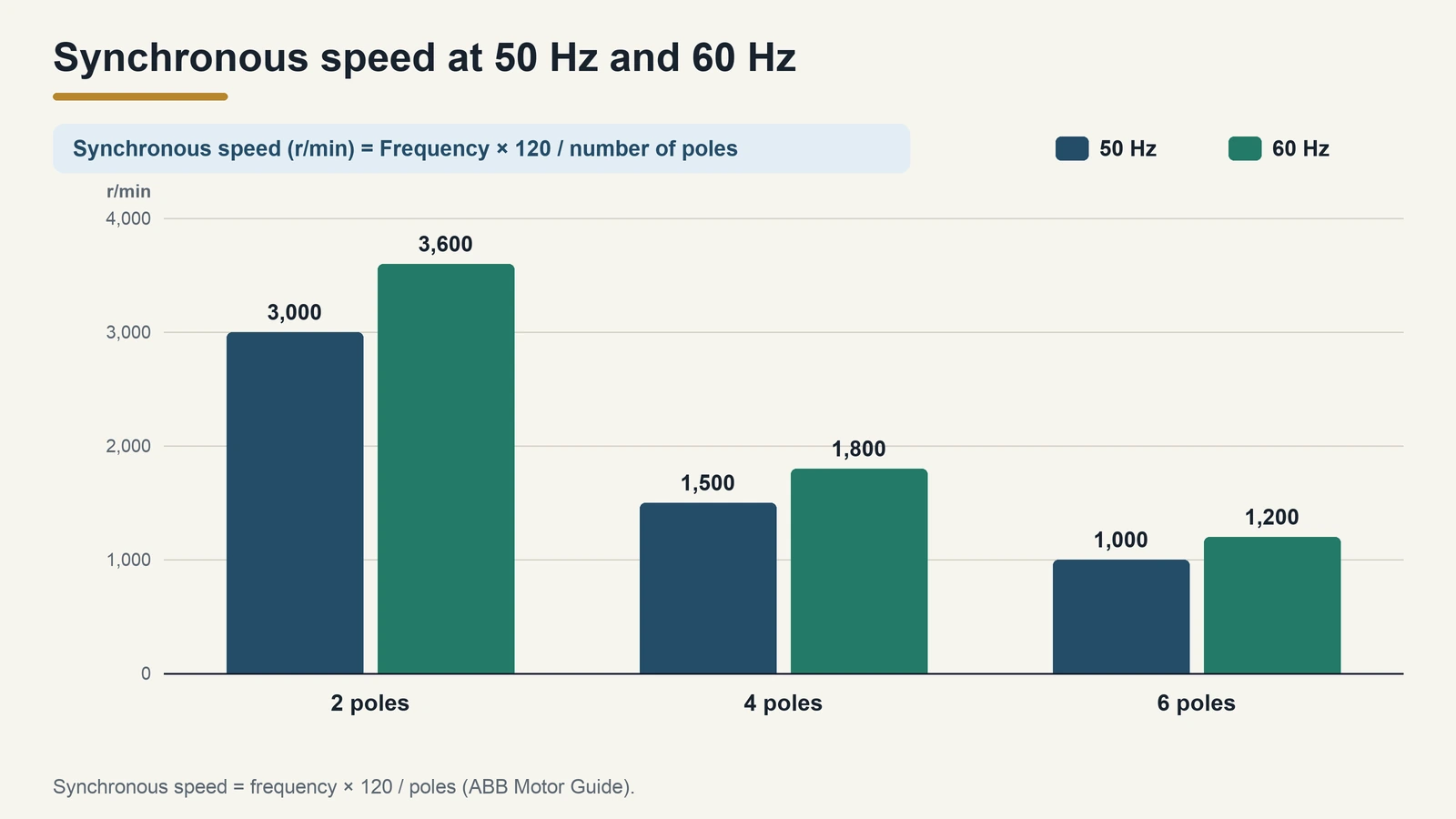
The speed of the magnetic field in an induction motor is set by the supply frequency and the number of poles. ABB's motor guide gives the formula:
Synchronous speed (r/min) = Frequency × 120 / number of poles
| Poles | At 50 Hz | At 60 Hz |
|---|---|---|
| 2 | 3,000 r/min | 3,600 r/min |
| 4 | 1,500 r/min | 1,800 r/min |
| 6 | 1,000 r/min | 1,200 r/min |
These are synchronous speeds. The actual shaft speed of an induction motor is a little lower because of slip.
For a machine, 20% more speed is not a small change. A pump, fan, conveyor or gearbox driven by that shaft also runs 20% faster, and the load on the motor changes with it.
How much frequency variation is allowed?
Not much. ABB's motor guide explains that the effect of voltage and frequency changes on temperature rise "is defined in IEC 60034-1":
| Zone | Voltage deviation | Frequency deviation | ABB's note |
|---|---|---|---|
| A | ±5% | ±2% | Rated torque available |
| B | ±10% | +3% / −5% | Rated torque available; "only for a short period of time" |
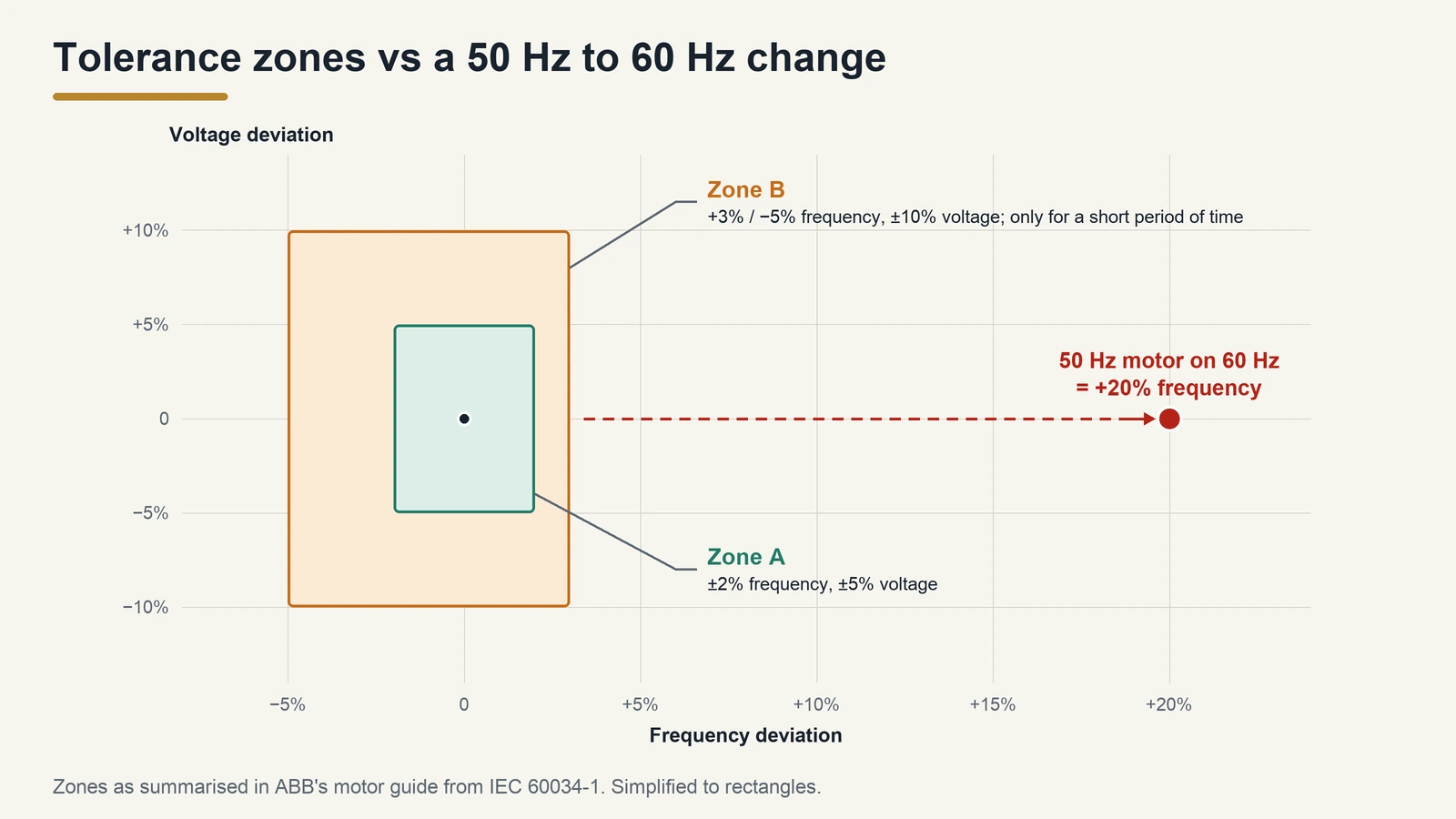
ABB adds that in both zones "the temperature rise will be higher than at rated voltage and frequency."
A move from 50 Hz to 60 Hz is a +20% frequency change. That is far outside both zones.
What else changes when the frequency changes?
Voltage and magnetic flux
ABB's guide notes that network voltage and frequency "vary between regions and countries of the world," and that "frequency is usually region-specific" while voltages can depend on the industry and application. A motor's winding is designed for a voltage at a given frequency. If the frequency rises but the voltage doesn't rise with it, the voltage-to-frequency (V/f) ratio falls, and so does the magnetic flux.
ABB describes the same effect for motors on frequency converters. Above the point where the voltage stops rising, "motor flux and capability to produce torque reduce." The torque the motor can deliver falls.
Cooling
A motor's own fan turns with the shaft, so its airflow changes with speed. For motors without their own fan, ABB's guide gives external airflow values for 50 Hz and says "with 60 Hz supply an increase of 20 % is needed."
When a motor runs above its nominal speed, ABB notes that "maximum torque and bearing construction should also be checked" and that, with a standard fan, "friction and cooling losses as well as the noise level will increase."
Temperature rise
Outside the rated point, temperature rise goes up, as ABB's note on zones A and B shows.
Can I just run a 50 Hz motor on 60 Hz?
Not without checking. The motor may be designed for both frequencies, for one only, or for one with specific voltage conditions. Only the nameplate and the manufacturer's data tell you which.
What to do:
- Read the nameplate. ABB's guide says to "check data on the rating plate," paying "special attention to voltage and winding connection." Check the rated frequency (or frequencies) too.
- If the nameplate doesn't cover the destination supply, don't connect it. Order a motor for that supply, or ask the manufacturer.
- If a frequency converter is used, the drive and motor settings must be chosen by a qualified person for that motor. We don't give drive settings or wiring instructions here.
For how to read each field, see our guide to reading a motor nameplate. For motors designed for converter supply, see variable-frequency motor vs standard motor.
What should I tell my motor supplier?
When your machine will run in another country, send:
- Destination supply voltage and frequency, for example 460 V 60 Hz. Check with the end user rather than assuming.
- Power and speed the machine needs at the destination frequency.
- Starting method and whether a frequency converter is used.
- Mounting, frame size and enclosure (IP rating).
- Any market rules your customer must meet.
Red Flag Motor's range includes YTE (YE2) and YTE2 (YE3) high-efficiency three-phase induction motors and YVP2 variable-frequency motors, among others. MOQ, lead time and payment terms depend on the motor model; send your requirements and we will confirm the options.
FAQ
Does a motor run faster on 60 Hz than on 50 Hz?
Yes. Synchronous speed is proportional to frequency, so a 4-pole motor's synchronous speed goes from 1,500 r/min at 50 Hz to 1,800 r/min at 60 Hz.
What frequency tolerance does IEC 60034-1 allow?
ABB's motor guide, summarising IEC 60034-1, gives ±2% for zone A and +3/−5% for zone B, with zone B for short periods only.
Can I use a 50 Hz motor in a 60 Hz country?
Only if its nameplate and the manufacturer's data cover that supply. Otherwise, order a motor for the destination voltage and frequency.
Does a frequency converter solve the problem?
It can change the frequency the motor sees, but the motor and drive must be matched by a qualified person. Check the nameplate and the drive maker's instructions.
Send your destination supply
Tell us the destination voltage and frequency, the power and speed, and how the motor is mounted. Shawn is an authorized export sales agent for Red Flag Motor. We usually reply within one working day (GMT+8). Certificate copies available on request. Products · Contact
Sources
| Source | What it supports | Checked |
|---|---|---|
| IEC 60034-1:2022 — Rotating electrical machines, Part 1: Rating and performance (IEC webstore abstract) | Scope; 14th edition replacing 2017 edition | 2026-11-17 |
| ABB — Low voltage motors: Motor guide (July 2019, PDF) | Synchronous speed formula; zones A and B per IEC 60034-1; 60 Hz cooling air +20%; operation above nominal speed; flux in field weakening; rating plate check | 2026-11-17 |