
How to Read an Electric Motor Nameplate (IEC Motors)
What kW, voltage, frequency, current, speed, duty type, insulation class, IP and IE code on an IEC motor nameplate mean, and what to send for a quote.
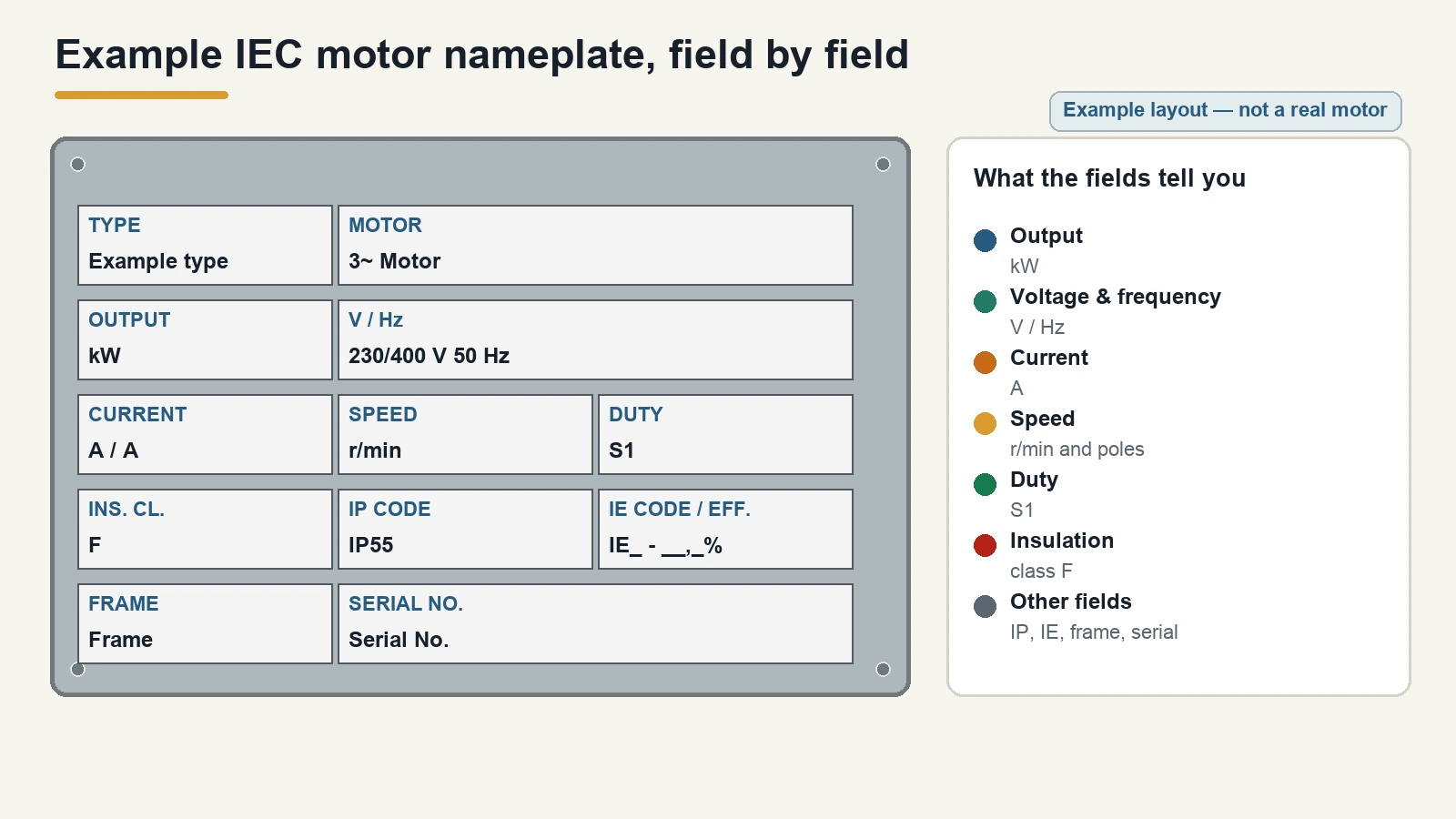
When you replace a motor, quote a machine or compare two suppliers, the nameplate is where you start. It is a small metal plate with a lot of abbreviations. Read it correctly and you can describe the motor you need in one message. Misread it and the replacement may not fit your supply, your duty cycle or your machine.
This guide goes through the fields you usually see on the plate of a three-phase induction motor built to IEC standards: what each one means and what to tell a supplier.
The standard behind the plate
The rating of a motor built to IEC practice is covered by IEC 60034-1, Rotating electrical machines – Part 1: Rating and performance. The IEC describes it as applicable to all rotating electrical machines, except machines for rail and road vehicles. The 2022 edition is the fourteenth. The IEC Webstore also lists a 2026 edition.
IEC 60034-1 is a paid standard. Below, where we explain how IEC practice differs from the North American NEMA standard, we quote NEMA's public comparison of the two.
Output: kW
The kW figure is the rated output power: the mechanical power the motor is designed to deliver at the shaft at its rated conditions. It is not the power drawn from the supply. The motor takes in more than it delivers, and the difference is its losses.
When you ask for a replacement, give the kW from the plate. A motor that is "about the same size" is not enough.
Voltage and frequency
The plate shows the rated voltage and frequency, for example 400 V 50 Hz. Some plates show two voltages, such as 230/400 V. NEMA's comparison lists 230/400 among the IEC nominal voltages at 50 Hz. A plate with two voltages is designed to be connected one way for the lower voltage and another way for the higher one. The connection for each is shown on the plate or in the terminal box. Follow that diagram and the maker's instructions; don't improvise the connection.
How far can the supply vary? NEMA's comparison summarises the IEC limits as two zones:
- Zone A: voltage ±5% and frequency ±2%.
- Zone B: voltage ±10% and frequency +3% / −5%.
Check that your actual supply fits the rated voltage and frequency on the plate.
Current: A
The current in amperes is the rated current at rated output, voltage and frequency. On a dual-voltage plate there are two currents, one for each voltage.
The current figure is what your electrician uses to size protection and cables. It also helps you check a replacement against the motor you are taking out.
Speed: r/min and poles
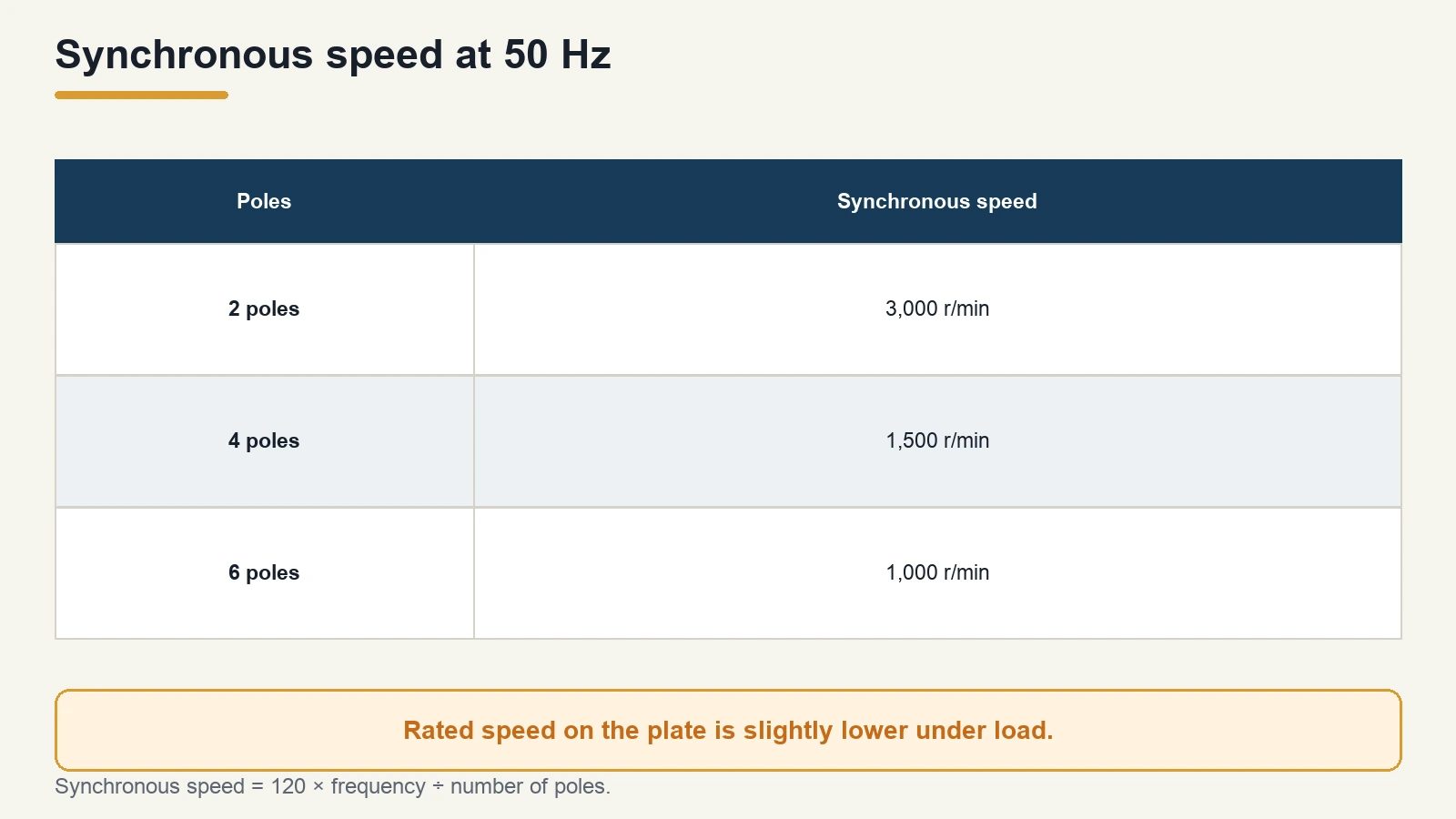
The plate gives the rated speed in revolutions per minute, for example 1450 r/min. That is the speed at full load. An induction motor runs slightly below its synchronous speed, which is set by the supply frequency and the number of poles.
Example (our calculation):
- Synchronous speed = 120 × frequency ÷ number of poles.
- A 4-pole motor on 50 Hz: 120 × 50 ÷ 4 = 1,500 r/min synchronous.
- The rated speed on the plate will be a little below that.
A 2-pole motor on 50 Hz works out at 3,000 r/min synchronous, and a 6-pole motor at 1,000 r/min. If you know the pole count or the rated speed, give it in your enquiry.
Duty: S1 to S10
This field is easy to overlook and important to get right. NEMA's comparison explains that IEC "does not recognize the use of service factor". Instead, IEC "specifies a 'Duty Type' for each motor design", and the purchaser "must specify duty".
The ten duty types, as NEMA lists them:
| Duty type | Description |
|---|---|
| S1 | Continuous |
| S2 | Short time |
| S3 | Intermittent periodic |
| S4 | Intermittent periodic with starting |
| S5 | Intermittent periodic with electric braking |
| S6 | Continuous operating periodic |
| S7 | Continuous operating periodic with electric braking |
| S8 | Continuous operating with related load/speed changes |
| S9 | Duty with non-periodic load and speed variations |
| S10 | Duty with discrete constant loads and speeds |
A motor rated S1 is rated for continuous running at its rated load. If your machine starts and stops often, or runs short bursts, say so. The duty type has to match how the machine really works.
Insulation class
The insulation class (for example F) gives the thermal class of the winding insulation system. It is not a rating for the surrounding air. NEMA's comparison lists these classes with their temperatures:
| Class | Temperature |
|---|---|
| A | 105 °C |
| B | 130 °C |
| F | 155 °C |
| H | 180 °C |
NEMA notes that IEC "identifies many thermal classes" by maximum allowable total temperature. The class on the plate is what the winding is designed for. When you replace a motor, match it, or ask the supplier to confirm what the replacement uses.
Other fields you will usually see
- IP code, for example IP55: protection against solids and water. See our guide to IP protection ratings.
- IE code and efficiency: NEMA's comparison says that for IEC motors "the rated efficiency and IE code shall be marked on the nameplate", and gives the example "IE2-84,0%". See our guide to IE2, IE3 and IE4 efficiency classes.
- Frame size and mounting: frame and mounting arrangement decide whether a replacement fits the machine mechanically.
- Type designation and serial number: the maker's model code and the individual motor's number. A photo of the whole plate saves a lot of back and forth.
What to send for a quotation
If you are replacing a motor or specifying a new one, send:
- A clear photo of the nameplate.
- Power in kW, voltage and frequency.
- Rated speed or number of poles.
- Duty type (S1 or other) and a short description of how the machine runs.
- Mounting and frame size.
- Quantity.
Shawn is an authorized export sales agent for Red Flag Motor (Qingdao Tianyi Group Red Flag Motor Co., Ltd., founded in 1976). The Red Flag range includes YTE (YE2) and YTE2 (YE3) high-efficiency three-phase induction motors, YVP2 variable-frequency motors, THE/TQE permanent-magnet synchronous motors, FYQ/FYQQ and FO textile motors, and IEC aluminium-frame motors. MOQ, lead time and payment terms depend on the motor model. Certificate copies are available on request.
FAQ
What does S1 mean on a motor nameplate?
S1 is continuous duty: the motor is rated to run continuously at its rated load. NEMA's comparison of the standards lists S1 to S10 as the IEC duty types.
What does insulation class F mean?
It is the thermal class of the winding insulation. NEMA lists Class F at 155 °C. It is not the maximum room temperature.
Why is the rated speed lower than 1,500 r/min on a 4-pole motor?
1,500 r/min is the synchronous speed of a 4-pole motor on 50 Hz. An induction motor runs slightly below its synchronous speed under load, so the rated speed is a little lower.
My plate says 230/400 V. Which one do I use?
The motor can be connected for either voltage, and the plate or terminal box shows the connection for each. Ask a qualified electrician to connect it for your supply, following the maker's diagram.
Does IEC use a service factor?
No. NEMA's comparison says IEC does not recognise service factor and uses duty types instead.
Get a quotation
Send your nameplate photo and requirements through our contact page, or browse the Red Flag product range. For choosing a motor from scratch, see how to choose the right electric motor.


