When to Use a Variable-Frequency Motor (YVP2) Instead of a Standard Motor on a VFD
When a standard induction motor can run on a VFD and when to pick a variable-frequency motor like YVP2: low-speed cooling, insulation, cables, bearings.
A standard three-phase induction motor can often run on a variable-frequency drive (VFD), especially on fans and pumps over a moderate speed range. Choose a motor designed for converter supply, such as Red Flag's YVP2 variable-frequency series, when the duty pushes past what a standard motor was built for. The usual cases are a constant-torque load running for long periods at low speed, a long motor cable or higher supply voltage that stresses the winding insulation, and installations where bearing currents are a concern. Whatever you choose, confirm cooling, insulation and speed range on the motor's data sheet.
This guide explains the four checks: cooling, low-speed torque, insulation and cables, and bearings. It doesn't give wiring or drive settings. Those come from the motor and drive manufacturers' manuals.
Can a standard induction motor run on a VFD?
Often, yes. The question is not whether it turns, but whether it stays within its limits for the duty you need.
IEC's application guide for this, IEC TS 60034-25:2022, "describes the performance characteristics of AC electrical machines for use on converter supplies". It also defines design features for machines "specifically designed for converter duty". The 2022 edition adds definitions of a "converter capable motor" and a "converter duty motor", and an annex on derating. So the standard itself treats a motor on a converter as a combination to check, not a plug-in swap.
Why does a standard motor overheat at low speed on a VFD?
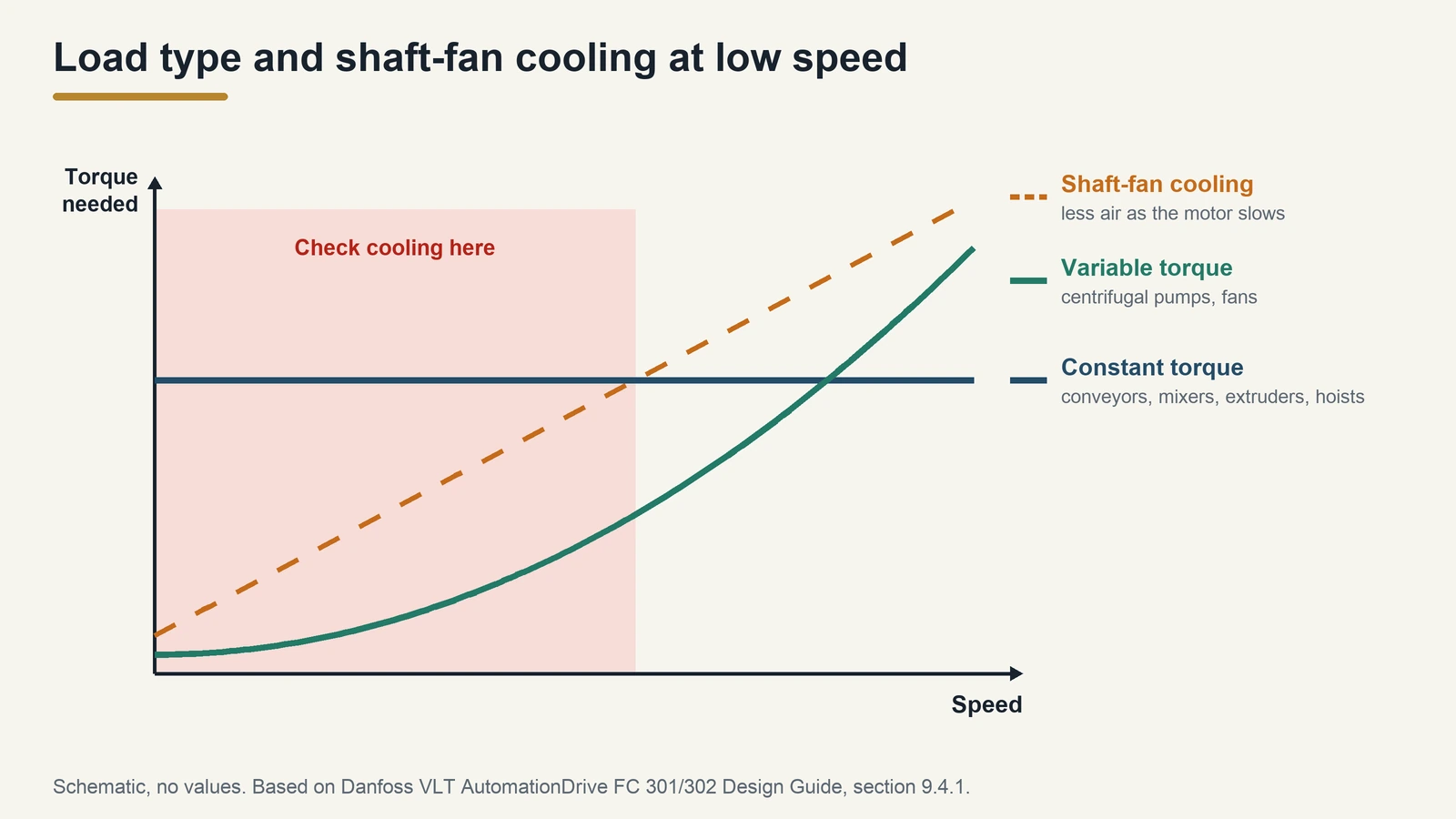
Because its cooling fan is on the motor shaft. When the drive slows the motor, the fan slows too, and less air flows over the frame.
Danfoss's design guide for its VLT AutomationDrive FC 301/302 puts it this way: "In a constant torque application, a motor may overheat at low speeds due to less cooling air from the motor integral fan." Its advice is that if the motor will run continuously below half its rated speed, it "must be supplied with extra air cooling (or a motor designed for this type of operation may be used)".
The load type decides how much this matters:
| Load type | Torque at low speed | Examples | Low-speed cooling issue (per Danfoss) |
|---|---|---|---|
| Variable (quadratic) torque | Falls with the square of speed | Centrifugal pumps, fans | "No need for extra cooling or derating of the motor" |
| Constant torque | Stays roughly the same | Conveyors, mixers, extruders, hoists | May overheat at low speed; add cooling or use a suitable motor |
When does low-speed torque make a variable-frequency motor the better choice?
When you need full torque at low speed for long periods. A constant-torque machine, such as a conveyor that runs slowly for hours, is the classic case.
You have three options, as Danfoss lists them: add separate air cooling, choose "a motor designed for this type of operation", or "reduce the load level of the motor by selecting a larger motor". Danfoss adds that "the design of the drive limits the motor size".
For a YVP2 motor, ask us to confirm with the factory:
- The speed range with constant torque, and with constant power above base speed, if you need it.
- The cooling method: shaft fan or separately powered fan.
- The rated torque at your lowest continuous speed.
How do VFD voltage pulses affect motor insulation?
A PWM drive doesn't send a smooth sine wave. Its output is a series of fast voltage pulses. Danfoss explains that at each switching event the voltage at the motor terminals rises at a rate that depends on the motor cable, meaning its type, cross-section, length and shielding, and on the motor's high-frequency impedance. Because of the mismatch between cable and motor, "a wave reflection occurs, causing a ringing voltage overshoot at the motor terminals".
That overshoot stresses the winding insulation. Two points from Danfoss's guides:
- "Modern motors for use with drives have a high degree of insulation". For older motors, "confirm the motor insulation or mitigate with dU/dt filter or, if necessary, a sine-wave filter."
- For 690 V applications, Danfoss's output filter guide says: "For motors not specially designed for frequency converter operation or without double insulation, Danfoss highly recommend the use of either dU/dt or Sine-Wave filters."
Danfoss also notes that different limit lines apply to different motor types. IEC 60034-17 covers general-purpose motors on converters, IEC 60034-25 covers converter-rated motors, and NEMA MG1 covers definite-purpose inverter-fed motors. That is why the motor's insulation rating for converter supply needs to be on its data sheet.
Does motor cable length matter on a VFD?
Yes. Cable length is one of the factors that shape the voltage pulse at the motor, according to Danfoss's design guide. Long cables, high supply voltages and parallel cables are the cases to check with both the drive and the motor manufacturer before installation. The allowed cable length depends on the drive model, any output filter, and the motor's insulation, so it comes from those manuals, not from a general rule.
What about bearing currents?
Drives can cause them. Danfoss explains that fast switching combined with common-mode voltage "generate high-frequency bearing currents and shaft voltages", which also occur on direct-on-line motors but are "accentuated when the motor is fed from a drive". The same guide adds that most bearing damage in drive-fed motors still comes from mechanical causes: "vibrations, misalignment, excessive axial or radial loading".
The options Danfoss lists include insulated bearings and careful grounding and installation. If bearing currents matter for your machine, ask whether the motor offers an insulated bearing option and follow your drive maker's installation guide.
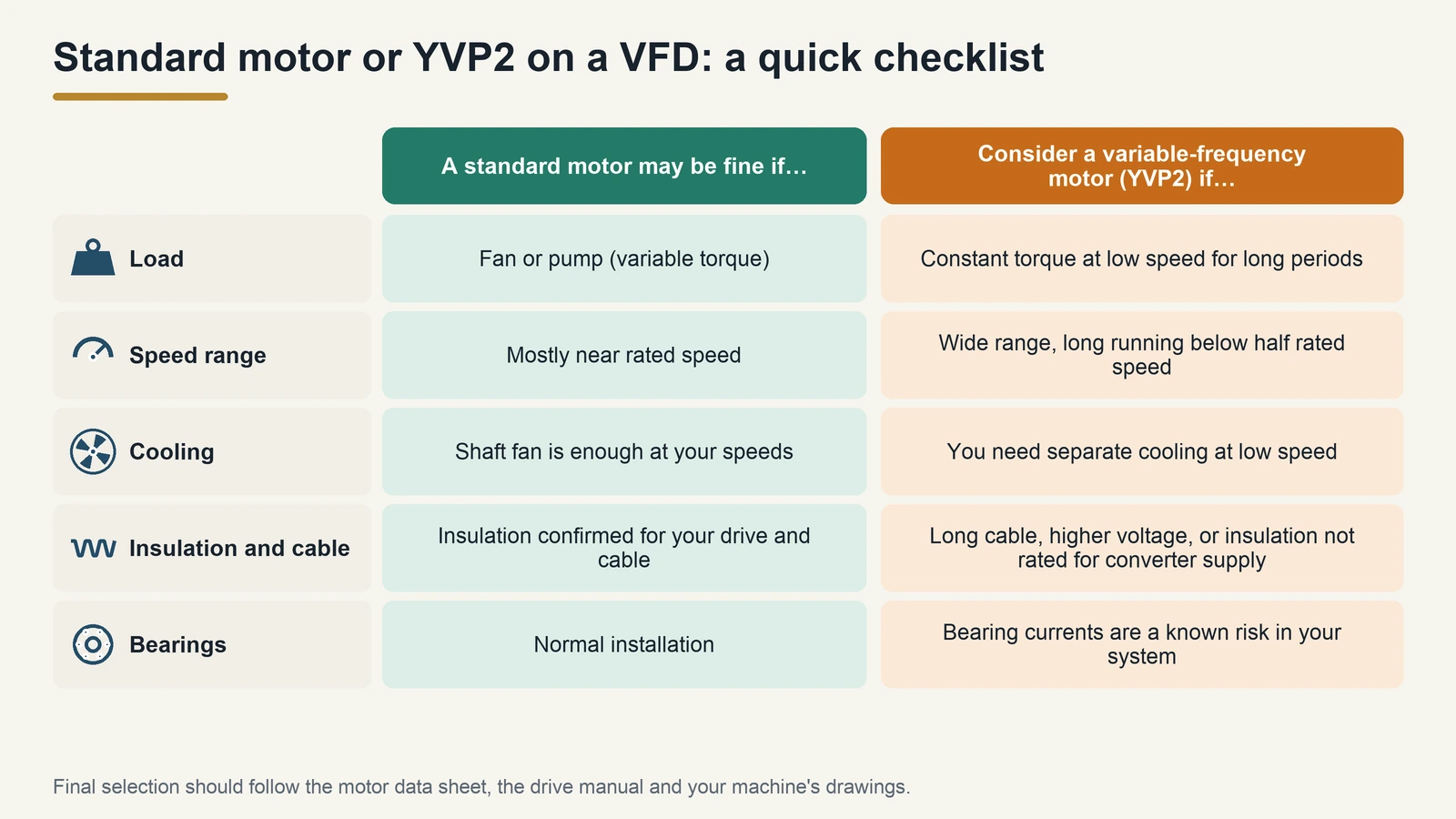
Standard motor or YVP2: a quick checklist
| Check | A standard motor may be fine if… | Consider a variable-frequency motor (YVP2) if… |
|---|---|---|
| Load | Fan or pump (variable torque) | Constant torque at low speed for long periods |
| Speed range | Mostly near rated speed | Wide range, long running below half rated speed (Danfoss's threshold for extra cooling) |
| Cooling | Shaft fan is enough at your speeds | You need separate cooling at low speed |
| Insulation and cable | Insulation confirmed for your drive and cable | Long cable, higher voltage, or insulation not rated for converter supply |
| Bearings | Normal installation | Bearing currents are a known risk in your system |
Final selection should follow the motor data sheet, the drive manual and your machine's drawings.
FAQ
Can I run a normal motor on a variable-frequency drive?
Often, for fans and pumps or modest speed ranges. Check cooling at low speed, insulation for converter supply, and cable length with the motor and drive manufacturers.
Why does my motor get hot at low speed on a VFD?
Its shaft-mounted fan slows down with the motor. Danfoss notes that constant-torque loads may overheat at low speed and need extra cooling or a motor designed for that duty.
What is the difference between a converter capable and a converter duty motor?
IEC TS 60034-25:2022 defines both terms. The definitions are in the paid standard, so check the edition your specification cites.
Do you give VFD wiring or parameter settings?
No. Follow the drive manufacturer's manual and the motor's data sheet for wiring, settings and filters.
Ask about YVP2 motors
Red Flag motors are made by Qingdao Tianyi Group Red Flag Motor Co., Ltd., founded in 1976. Shawn is an authorized export sales agent for Red Flag Motor. MOQ, lead time and payment terms depend on the motor model. Send the power, poles, voltage and frequency, the speed range and load type, the drive model and the cable length, and we will check YVP2 options with the factory. Certificate copies are available on request. Read how to choose an electric motor, see the product range, or contact us.
Sources
| Source | URL | Checked |
|---|---|---|
| IEC, IEC TS 60034-25:2022, "Rotating electrical machines – Part 25: AC electrical machines used in power drive systems – Application guide" (abstract) | https://webstore.iec.ch/en/publication/66456 | 2026-11-15 |
| Danfoss, Design Guide VLT® AutomationDrive FC 301/302 0.25–75 kW (2019): 5.1.1.1 motor insulation, 5.1.1.4 bearing currents, 9.4.1 derating for running at low speed, 10.9.3–10.9.4 | https://assets.danfoss.com/documents/272132/AJ286655760917en-002201.pdf | 2026-11-15 |
| Danfoss, Output Filters Design Guide (VLT FC 100/200/300): motor insulation, limit lines | https://assets.danfoss.com/documents/277639/AJ361178726334en-000501.pdf | 2026-11-15 |