Insulation Class F and Temperature Rise B: What They Mean in Hot Climates
What insulation class F with temperature rise class B means, why it is not a licence to overload, and how ambient temperature, altitude and VFDs change it.
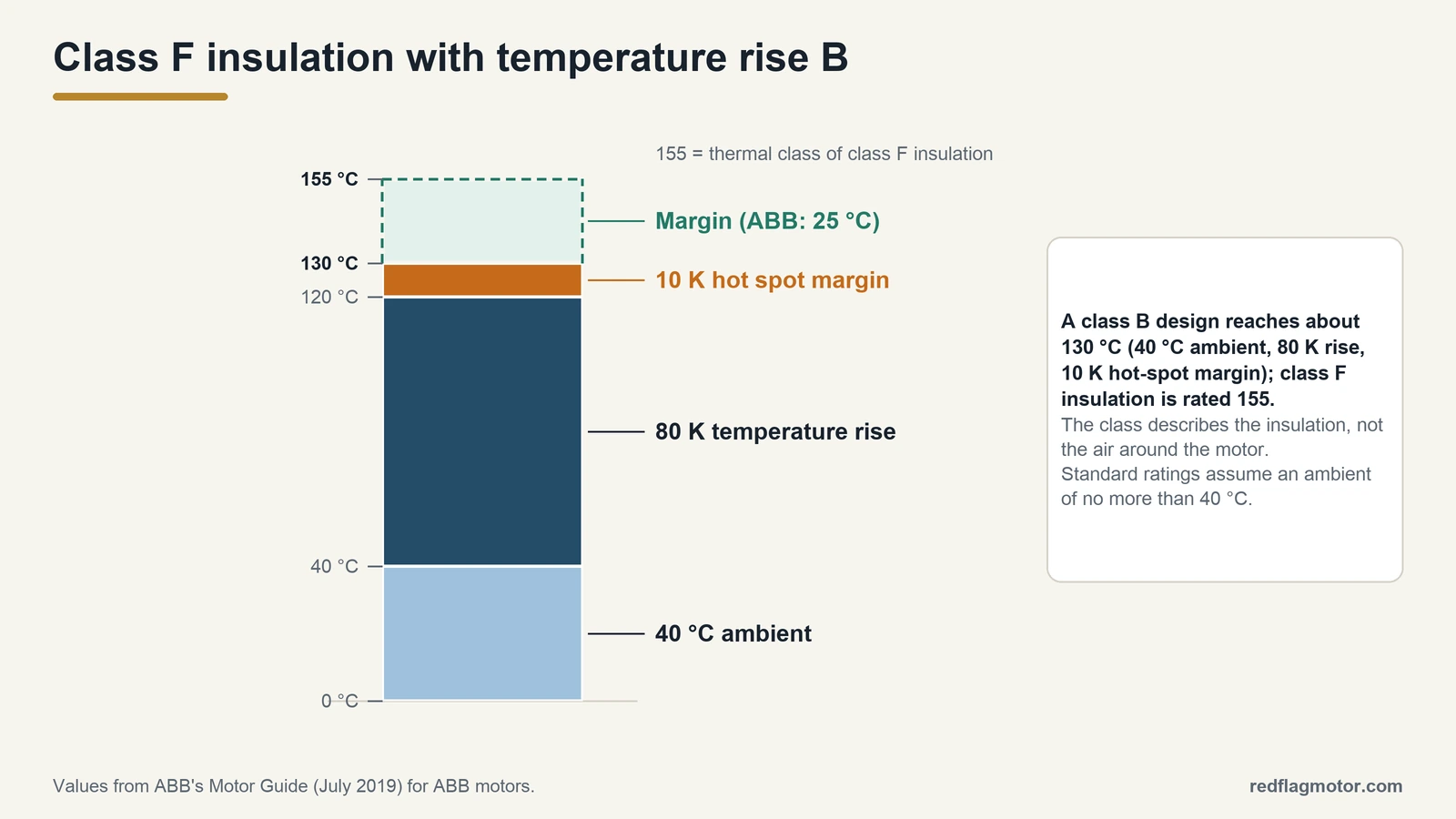
Insulation class F is the thermal class of a motor's winding insulation system: thermal class 155. "Temperature rise B" means the motor is designed so that its winding temperature rise stays within the class B limit, which ABB gives as 80 K at a 40 °C ambient. The gap between the two is a margin. It is not permission to overload a motor in any climate. Standard ratings assume an ambient of no more than 40 °C and an altitude of no more than 1000 m; beyond that, the motor maker's derating applies.
This guide explains the two classes, what the margin is for, and what to tell your supplier when a motor will run in a hot place.
What is insulation class F?
Insulation class F is the thermal class of the winding insulation, designated 155. IEC 60085 is the IEC standard that sets out how thermal classes for electrical insulation are evaluated and assigned. NEMA's comparison of NEMA and IEC motor standards lists the IEC thermal classes by "maximum allowable total temperature":
| Letter | Thermal class (°C) |
|---|---|
| B | 130 |
| F | 155 |
| H | 180 |
The class describes the insulation, not the air around the motor. Class F does not mean the motor can work in a 155 °C room. Our guide to reading a motor nameplate shows where the class appears on the plate.
What does "temperature rise B" mean?
Temperature rise is how much hotter the winding gets than the surrounding air when the motor runs at its rating. "Temperature rise B" means the rise is kept within the limit for class B, even though the insulation itself is class F.
ABB's Motor Guide (July 2019) gives these values for its motors:
| Thermal class | Nominal ambient | Max. permissible temperature rise | Hot spot margin |
|---|---|---|---|
| 130 | 40 °C | 80 K | 10 K |
| 155 | 40 °C | 105 K | 10 K |
| 180 | 40 °C | 125 K | 15 K |
NEMA's comparison gives the same 80 K for class B and 105 K for class F, for low-voltage random-wound motors with a 1.0 service factor, "based on 40°C ambient."
ABB also says that "class F insulation, which, with temperature rise class B, is the most commonly required insulation system for industrial motors."
Why is F insulation with B rise called a safety margin?
Because the motor is designed to run cooler than its insulation allows. On ABB's figures, a class B design reaches about 130 °C (40 °C ambient, 80 K rise, 10 K hot-spot margin), while class F insulation is rated 155. ABB calls this "a 25 °C safety margin" for its products.
ABB lists what that margin can be used for:
- to increase the loading of the motor "for limited periods";
- to operate at higher ambient temperatures or altitudes;
- to cope with greater voltage and frequency tolerances;
- to extend insulation life. ABB notes that "already a 10 K temperature reduction has a relevant effect on insulation lifetime."
These are ABB's statements about ABB motors. Whether a particular motor may use its margin, and for which of these purposes, is for that motor's manufacturer to confirm. The margin is not spare capacity you can count on for continuous overload.
What changes when the motor runs in a hot climate?
The rating assumes a cool enough site. ABB's guide says that "normal motors are designed for operation at a maximum ambient temperature of 40 °C and at a maximum altitude of 1000 meters above sea level," and that a motor run at higher ambient temperatures "should be derated." NEMA's comparison gives the same 40 °C and 1000 m as the limits without compensation, for both NEMA and IEC.
ABB publishes a derating table for its own motors. Example from ABB's Table 4.1 (ABB motors only):
| Ambient temperature | Permitted output (% of rated) |
|---|---|
| 40 °C | 100 |
| 45 °C | 96.5 |
| 50 °C | 93 |
| 55 °C | 90 |
| 60 °C | 86.5 |
The same table also reduces output above 1000 m altitude. Other manufacturers publish their own figures, and they may differ. For a Red Flag motor, ask us: we confirm the derating for the exact model with the factory rather than apply another maker's table.
Two more points for hot, humid sites:
- The ambient is the air at the motor.
- Humidity and condensation. ABB notes that a cooling motor "may suck in particles and humidity that could damage bearings and insulation," and that heating elements in the winding heads may be needed when the temperature difference to the ambient air is high. If your site is humid, tell us when you send your requirements.
Do supply voltage and variable-frequency drives affect temperature rise?
Yes. ABB's guide, summarising IEC 60034-1, says a motor can supply rated torque within the voltage and frequency tolerance zones, "but the temperature rise will be higher than at rated voltage and frequency," and that the wider zone B is for short periods only.
On a variable-frequency drive, ABB says the continuous load a motor can carry depends on the converter's modulation pattern and switching frequency as well as on the motor. ABB adds that if a catalogue gives class F temperature rise on sinusoidal supply, the motor can only be dimensioned to the class B curve when it runs on a converter. ABB notes that "the air flow and cooling capacity depends on the fan speed," and mentions a separate constant-speed fan to increase cooling at low speeds.
Red Flag makes the YVP2 series for variable-frequency duty. Our guide to standard motors versus variable-frequency motors covers low-speed cooling in more detail.
What should I send when ordering a motor for a hot site?
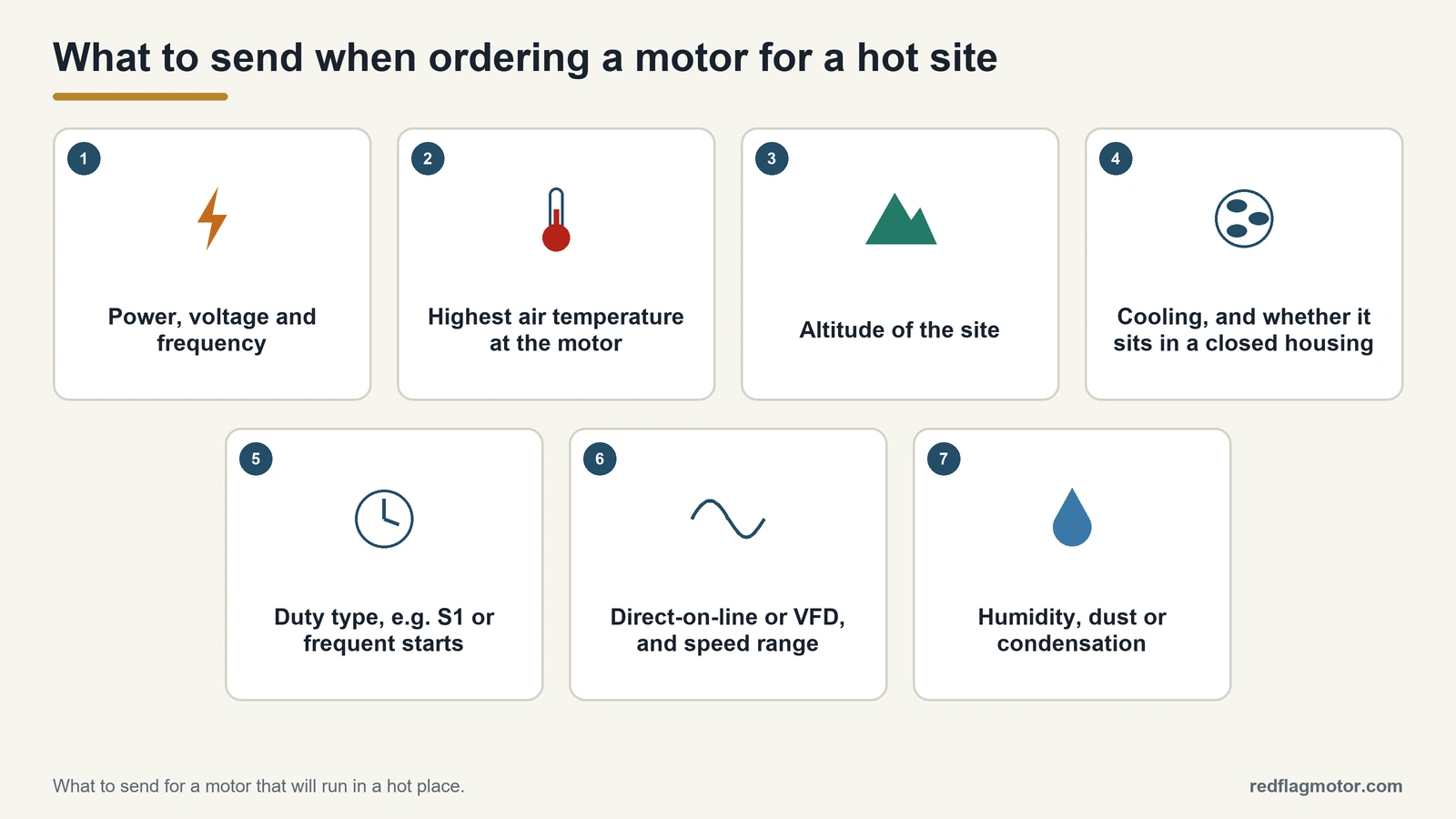
Send the facts that decide the temperature, not just the power:
- power, voltage and frequency;
- the highest air temperature at the motor, not only the local climate average;
- altitude of the site;
- how the motor is cooled and whether it sits inside a closed housing;
- duty type, for example continuous running (S1) or frequent starts;
- direct-on-line or on a variable-frequency drive, and the speed range;
- humidity, dust or condensation on site.
Our product pages list class F insulation for the motors shown. The temperature-rise class and any derating for your conditions depend on the model; we confirm the exact model with the factory.
FAQ
Does class F insulation mean the motor can run at 155 °C ambient?
No. 155 is the thermal class of the winding insulation. Standard ratings assume an ambient of no more than 40 °C.
Can I overload a motor with F insulation and B temperature rise?
Not as a rule. ABB says the margin can be used to increase loading "for limited periods," among other uses, for its own motors. Ask the manufacturer before running any motor above its rating.
What happens above 40 °C ambient?
The motor's permitted output goes down. ABB's table for its motors, for example, permits 93% of rated output at 50 °C. Use the manufacturer's own derating for the motor you buy.
Do your motors have temperature rise class B?
Our product pages list class F insulation. Ask us for the temperature-rise class of the exact model you need.
Get a quote
MOQ, lead time and payment terms depend on the motor model; send your requirements. Certificate copies available on request. Hongqi (Red Flag) motors are made in Qingdao by Qingdao Tianyi Group Red Flag Motor Co., Ltd., founded in 1976; Shawn is an authorized export sales agent. See our motors or contact us. We usually reply within one working day (GMT+8).
Sources
| Source | What it supports | Checked |
|---|---|---|
| ABB, "Low voltage motors – Motor guide" (July 2019) | 4.2 insulation classes, temperature rise limits, 25 °C margin and its uses; 4.4 and Table 4.1 ambient, altitude and derating for ABB motors; 3.7 voltage and frequency zones; 5.5 humidity; 10.4 and p. 108 converter duty and fan cooling | 2026-11-21 |
| NEMA, "NEMA Motor Standards vs IEC Motor Standards" | Insulation classes and temperature rise limits at 40 °C ambient; IEC thermal classes; 40 °C and 1000 m without compensation | 2026-11-21 |
| IEC 60034-1:2022, IEC Webstore | Scope of IEC 60034-1 (rating and performance of rotating electrical machines); current edition | 2026-11-21 |
| IEC 60085:2007, EVS | IEC 60085 covers thermal evaluation and designation of electrical insulation | 2026-11-21 |
| Red Flag motors | Class F insulation on product pages | 2026-11-21 |