Permanent-Magnet Synchronous Motors vs Induction Motors: Where PMSM Makes Sense
Permanent-magnet synchronous motors vs induction motors: drives, IEC 60034-30-1 and 60034-30-2 efficiency classes, and where DOE says PM motors fit.
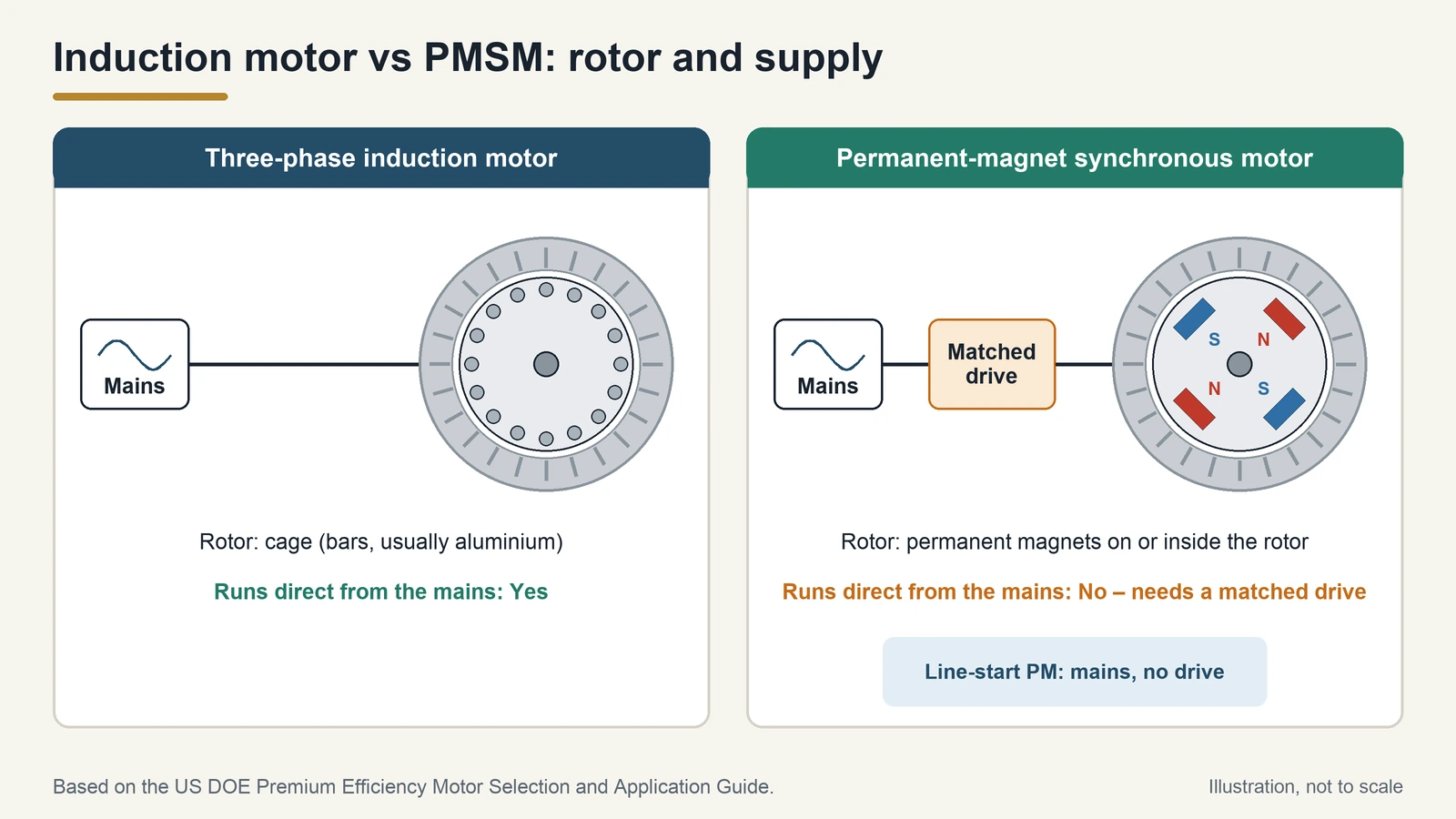
A permanent-magnet synchronous motor (PMSM) uses magnets in the rotor instead of the induction motor's rotor cage. The practical difference for a buyer is the drive. A three-phase induction motor can run straight from the mains. The US Department of Energy (DOE) motor guide says the PM motor "must be controlled by an inverter or variable speed drive that is specifically developed so the PM motor can start and achieve synchronization properly." That's why the DOE guide lists speed control first among the cases where PM motor drive systems should be considered.
This guide compares the two on efficiency classes, control, maintenance and cost, using IEC and DOE wording.
What is the difference between a PMSM and an induction motor?
| Three-phase induction motor | Permanent-magnet synchronous motor | |
|---|---|---|
| Rotor | Cage (bars, usually aluminium) | Permanent magnets on or inside the rotor |
| Runs direct from the mains | Yes | No – needs a matched drive (except line-start PM motors, below) |
| Speed | Slightly below synchronous speed | Synchronous speed |
| IEC efficiency class standard | IEC 60034-30-1 | IEC TS 60034-30-2 (drive-fed); line-start PM motors: IEC 60034-30-1 |
The DOE guide describes the PM design this way: magnets "attached to the surface of the rotor or interior to the rotor to establish a permanent magnetic field. This design replaces the traditional aluminum rotor cage of the induction motor and significantly reduces the secondary circuit rotor I2R losses."
Does a permanent-magnet motor need a drive?
Yes, in the usual design. The DOE guide says: "The PM motor is designed for variable speed operation, and must be controlled by an inverter or variable speed drive that is specifically developed so the PM motor can start and achieve synchronization properly."
So when you price a PMSM, price the drive with it. A general-purpose drive set up for induction motors isn't automatically suitable; check with the drive maker that it supports your PM motor.
What is a line-start PM motor?
It's a hybrid. The DOE guide describes the line-start permanent magnet motor (LSPM) as having "a rotor with an aluminum cage and internal permanent magnets," and says it "starts and accelerates directly connected to the line and without the need for a controller." It runs "at a fixed, synchronous speed regardless of load."
So "permanent-magnet motor" doesn't always mean "needs a drive." Ask which type a model is before you design the panel.
How are PMSM and induction motor efficiencies classified?
By two different IEC documents.
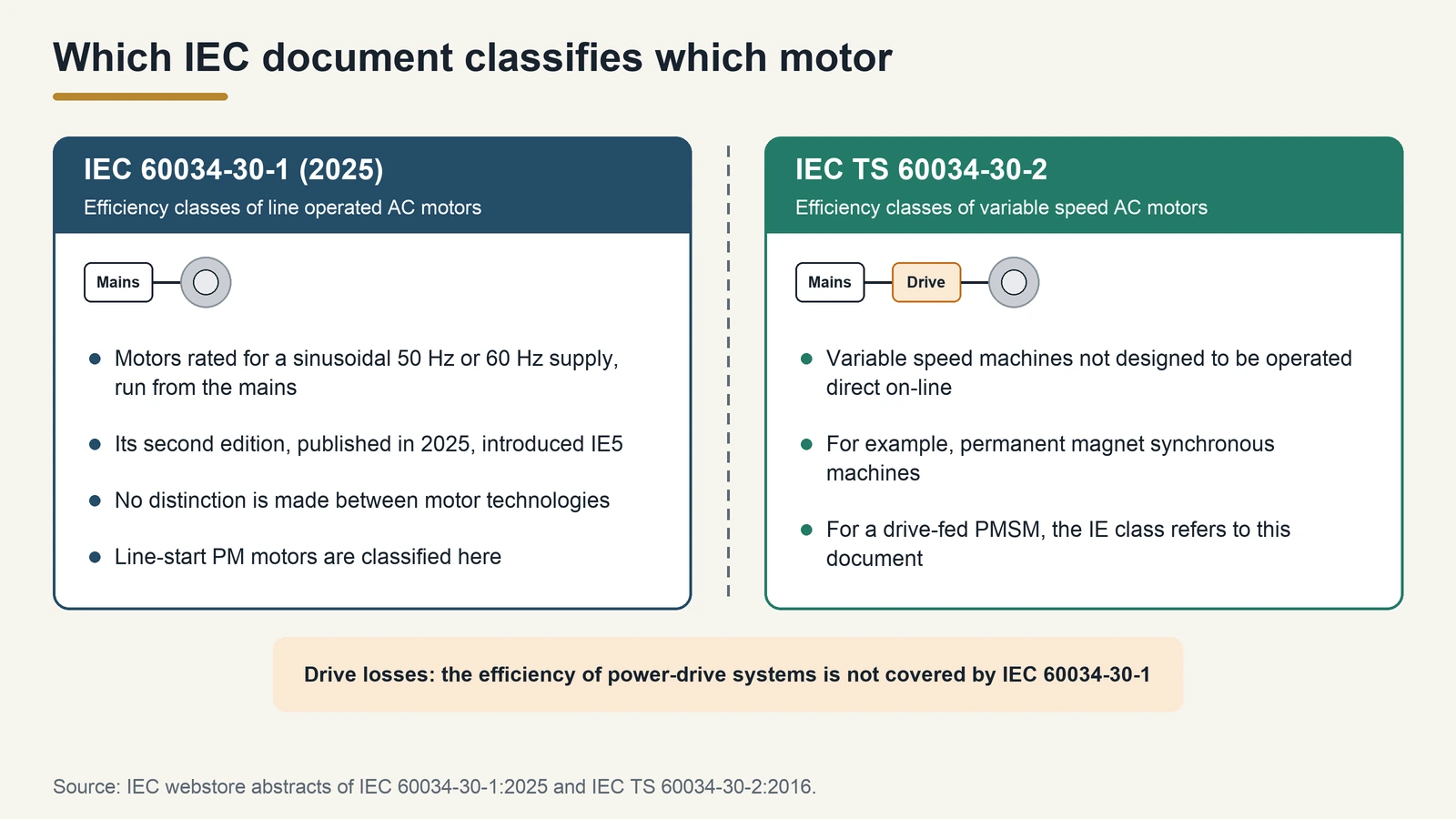
- IEC 60034-30-1 covers motors "rated for operation on a sinusoidal either 50 Hz or 60 Hz, or both voltage supply", meaning motors that run from the mains. Its second edition, published in 2025, introduced IE5. It also says: "No distinction is made between motor technologies … even though not all motor technologies are capable of reaching the higher efficiency classes."
- IEC TS 60034-30-2 covers "variable speed rotating electric machines not covered in IEC 60034-30-1", machines "that are not designed to be operated direct on-line (grid), for example permanent magnet synchronous machines."
Two points follow for buyers. First, for a PMSM that runs on a drive, the IE class refers to IEC TS 60034-30-2, not the mains-motor table. Second, IEC 60034-30-1 says "the efficiency of power-drive systems is not covered by this document". The drive's losses are a separate question.
For how the IE classes apply to our induction motors, see YE2 vs YE3: YTE and YTE2 motors.
What are the advantages and disadvantages of PM motors?
The DOE guide lists them as follows.
| DOE-listed advantages | DOE-listed disadvantages |
|---|---|
| Excellent torque-speed curve and dynamic response | High cost (volatile because of rare earth magnet prices) |
| High efficiency and reliability, low maintenance requirements | Need for a controller |
| Variable speed capability | |
| Higher efficiency at partial loads | |
| Longer lifetime | |
| Low acoustical noise | |
| High speed capability | |
| High torque-to-volume ratio (high power density) |
The guide also notes that PM motors "have an inherently high power factor." On servicing, it says that because of the strong rotor magnets, "care must be taken when removing or inserting the motor rotor."
These are DOE's general points about PM motors, not test results for any particular model.
Where does a PMSM make sense?
The DOE guide says "PM and SR motor drive systems should be considered" in these cases (SR is switched reluctance, another motor type):
- "When the application requires speed control (i.e., when an ASD is required for speed regulation)"
- "When driven equipment is in operation for over 2,000 hours per year"
- When an old standard-efficiency motor drives a centrifugal load "with throttled or damper flow control"
- "When operations involve frequent starts and stops"
- "When small motors operate at partial load a good deal of the time"
- When the motor can be used in direct drive to replace a motor with a gearbox, a gear motor or a belt drive
The PMSM's added cost includes the magnets and a drive, as the DOE disadvantages list shows. Whether a PMSM pays off depends on your duty cycle and energy price; we don't give a payback figure.
Which Red Flag motors are PMSM and which are induction?
Red Flag Motor's catalogue lists these series:
- YTE (YE2) and YTE2 (YE3): high-efficiency three-phase induction motors.
- YVP2: variable-frequency motors. See variable-frequency motor vs standard motor.
- THE / TQE: permanent-magnet synchronous motors.
Ask us whether the THE or TQE model you need runs on a drive, and which drive it's matched with. We confirm the exact model with the factory.
FAQ
Can a permanent-magnet synchronous motor run without a VFD?
A standard PMSM can't. The DOE guide says it must be controlled by an inverter or drive developed for it. Line-start PM motors are the exception: they start directly on the line.
Is a PMSM always more efficient than an induction motor?
Compare the class and the standard behind it. Efficiency classes for PMSMs not designed to run direct on-line are in IEC TS 60034-30-2; mains-operated motors are in IEC 60034-30-1. Ask for the class of the specific model.
What is the main disadvantage of a PM motor?
In DOE's list: high cost, which varies with rare-earth magnet prices, and the need for a controller.
Which IEC standard covers PMSM efficiency classes?
IEC TS 60034-30-2, for variable-speed machines not designed to run direct on-line.
Send your requirements
Shawn is an authorized export sales agent for Red Flag Motor (Qingdao Tianyi Group Red Flag Motor Co., Ltd.). MOQ, lead time and payment terms depend on the motor model; send your requirements. Certificate copies available on request. Contact us · All products
Sources
| Source | What it supports | Checked |
|---|---|---|
| IEC 60034-30-1:2025, Efficiency classes of line operated AC motors (IE code) – abstract | Scope (mains-operated motors), technology-neutral classes, IE5 added, drive-system efficiency not covered | 2026-11-17 |
| IEC TS 60034-30-2:2016, Efficiency classes of variable speed AC motors – abstract | Scope covers PMSM not designed for direct on-line operation | 2026-11-17 |
| US DOE, Premium Efficiency Motor Selection and Application Guide, chapter 7 | PM motor design, need for a drive, power factor, advantages and disadvantages, LSPM, applications | 2026-11-17 |